OSI Model
All communication on a network is organized using network protocols.
The OSI (Open Systems Interconnection) model is a conceptual framework created by the ISO. It standardizes how computer systems communicate over a network by dividing the process into 7 distinct abstract layers, making it easier to design, troubleshoot, and understand network architecture
- https://en.wikipedia.org/wiki/OSI_model ↗
The official documentation and foundational specification for the OSI (Open Systems Interconnection) model is published as ISO/IEC 7498-1, which was developed in collaboration with the International Telecommunication Union (ITU-T) as Recommendation X.200 - https://www.iso.org/ics/35.100/x/ ↗
The Transmission Control Protocol (TCP), establishes connections between two devices, and the Internet Protocol (IP), is used for routing and addressing data packets as they travel between devices on a network. These protocols are used on specific internet layers in the TCP/IP model.
The 4-layer TCP/IP model is a condensed form of the OSI model, which is made up of 7 layers.
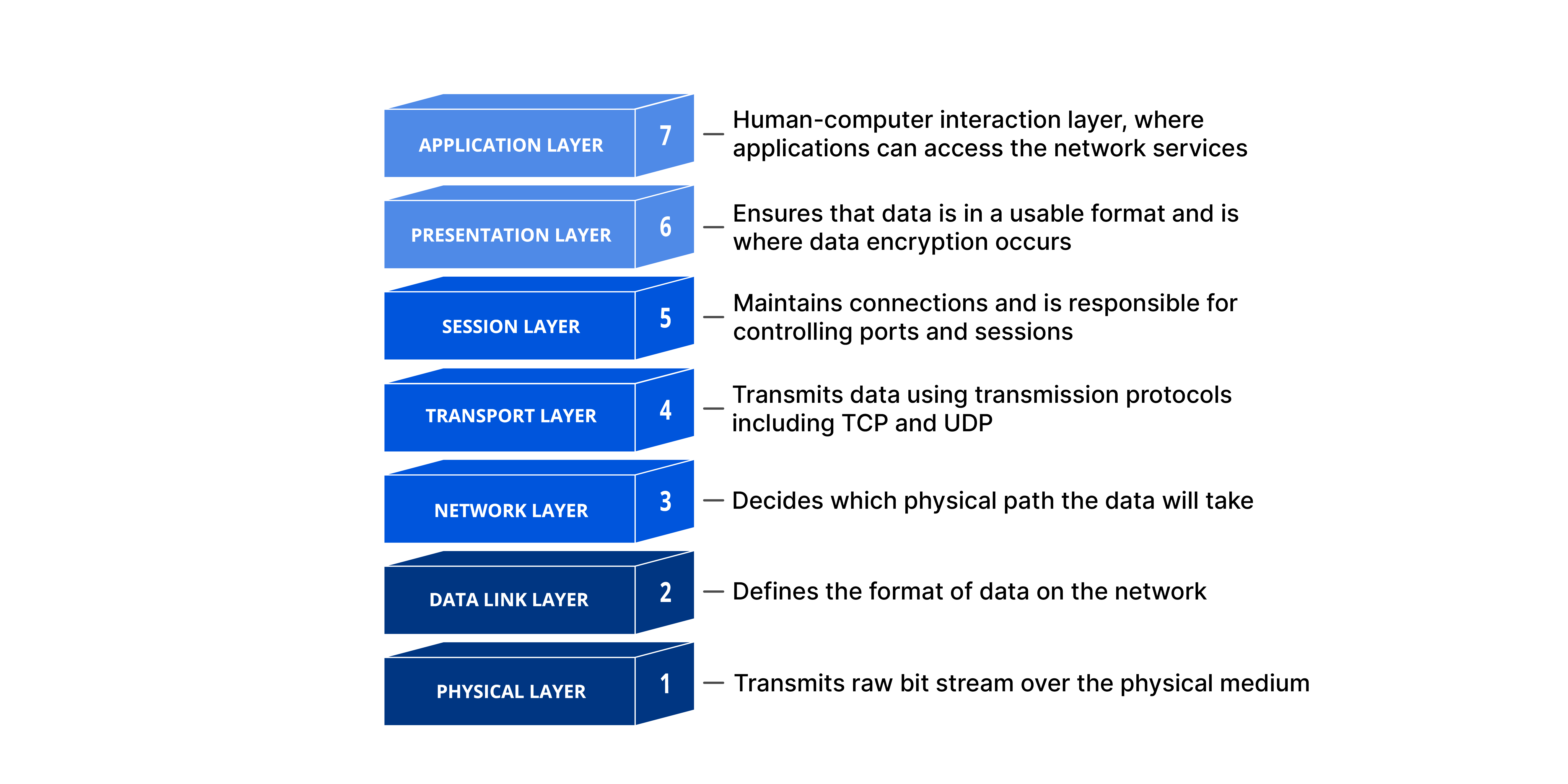
Layer 1: Physical layer #
As the name suggests, the physical layer corresponds to the physical hardware involved in network transmission. Hubs, modems, and the cables and wiring that connect them are all considered part of the physical layer. To travel across an ethernet or coaxial cable, a data packet needs to be translated into a stream of 0s and 1s. The stream of 0s and 1s are sent across the physical wiring and cables, received, and then passed on to higher levels of the OSI model.
Layer 2: Data link layer#
The data link layer focuses on the physical addressing of the transmission. It receives a packet from the network layer (including the IP address for the remote computer) and adds in the physical MAC (Media Access Control) address of the receiving endpoint. Inside every network-enabled computer is a Network Interface Card (NIC) which comes with a unique MAC address to identify it.
MAC addresses are set by the manufacturer and literally burnt into the card; they can’t be changed – although they can be spoofed. When information is sent across a network, it’s actually the physical address that is used to identify where exactly to send the information.
The data link layer organizes sending and receiving data packets within a single network. The data link layer is home to switches on the local network and network interface cards on local devices.
Protocols like network control protocol (NCP), high-level data link control (HDLC), and synchronous data link control protocol (SDLC) are used at the data link layer.
Layer 3: Network layer#
The network layer is where the magic of routing & re-assembly of data takes place (from these small chunks to the larger chunk).
The network layer oversees receiving the frames from the data link layer (layer 2) and delivers them to the intended destination. The intended destination can be found based on the address that resides in the frame of the data packets. Data packets allow communication between two networks. These packets include IP addresses that tell routers where to send them. They are routed from the sending network to the receiving network.
Routing simply determines the most optimal path in which these chunks of data should be sent using various protocols like OSPF (Open Shortest Path First) and RIP (Routing Information Protocol).
Layer 4: Transport layer#
The transport layer is responsible for delivering data between devices. This layer also handles the speed of data transfer, flow of the transfer, and breaking data down into smaller segments to make them easier to transport.
Segmentation is the process of dividing up a large data transmission into smaller pieces that can be processed by the receiving system. These segments need to be reassembled at their destination so they can be processed at the session layer (layer 5). The speed and rate of the transmission also has to match the connection speed of the destination system.
Networking/Network Protocols/TCP and Networking/Network Protocols/UDP are transport layer protocols.
Layer 5: Session layer#
A session describes when a connection is established between two devices. An open session allows the devices to communicate with each other. Session layer protocols keep the session open while data is being transferred and terminate the session once the transmission is complete.
The session layer is also responsible for activities such as authentication, reconnection, and setting checkpoints during a data transfer. If a session is interrupted, checkpoints ensure that the transmission picks up at the last session checkpoint when the connection resumes. Sessions include a request and response between applications. Functions in the session layer respond to requests for service from processes in the presentation layer (layer 6) and send requests for services to the transport layer (layer 4).
Layer 6: Presentation layer#
Functions at the presentation layer involve data translation and encryption for the network. This layer adds to and replaces data with formats that can be understood by applications (layer 7) on both sending and receiving systems. Formats at the user end may be different from those of the receiving system. Processes at the presentation layer require the use of a standardized format.
Some formatting functions that occur at layer 6 include encryption, compression, and confirmation that the character code set can be interpreted on the receiving system. One example of encryption that takes place at this layer is SSL, which encrypts data between web servers and browsers as part of websites with HTTPS.
Layer 7: Application layer#
The application layer includes processes that directly involve the everyday user. This layer includes all of the networking protocols that software applications use to connect a user to the internet. This characteristic is the identifying feature of the application layer—user connection to the internet via applications and requests.
An example of a type of communication that happens at the application layer is using a web browser. The internet browser uses HTTP or HTTPS to send and receive information from the website server. The email application uses simple mail transfer protocol (SMTP) to send and receive email information. Also, web browsers use the domain name system (DNS) protocol to translate website domain names into IP addresses which identify the web server that hosts the information for the website.
Summary#
| Layer Number | Layer Name | Main Function | Example Protocols and Standards |
|---|---|---|---|
| Layer 7 | Application layer | Providing services and interfaces to applications | HTTP, FTP, DNS, POP3, SMTP, IMAP |
| Layer 6 | Presentation layer | Data encoding, encryption, and compression | Unicode, MIME, JPEG, PNG, MPEG |
| Layer 5 | Session layer | Establishing, maintaining, and synchronising sessions | NFS, RPC |
| Layer 4 | Transport layer | End-to-end communication and data segmentation | UDP, TCP |
| Layer 3 | Network layer | Logical addressing and routing between networks | IP, ICMP, IPSec |
| Layer 2 | Data link layer | Reliable data transfer between adjacent nodes | Ethernet (802.3), WiFi (802.11) |
| Layer 1 | Physical layer | Physical data transmission media | Electrical, optical, and wireless signals |